There's a strange thing that happens when a roofing company starts to win. The phone rings more. The crews stay booked. Revenue climbs month over month. And somehow, the business feels harder to run than it did when you were smaller.
If you've ever stood in your office at 7 p.m. trying to figure out which crew is on which job tomorrow, whether the materials actually got ordered, and why a customer is calling angry about a job you thought closed last week — you already know the feeling. Growth didn't fix the chaos. Growth amplified it.
This is one of the most common and least talked-about realities in the trade. The skills that got a roofing company to $2 million don't automatically carry it to $10 million. At a certain size, hustle stops being enough, and the thing quietly holding you back isn't your sales, your crews, or your market. It's the absence of systems built to handle the volume you've created.
The good news: chaos in a growing roofing company is a solvable problem. Not by working harder or hiring one more person to "own it," but by building visibility, accountability, and connected workflows into how the business actually runs. This post walks through why the chaos shows up, what it quietly costs you, and what a calmer, more scalable operation looks like.
Why Chaos Happens in Growing Roofing Companies
Roofing is uniquely prone to operational chaos, and it's worth understanding why before trying to fix it.
A roofing job touches more moving parts than almost any other home service transaction. A single project might involve a canvasser, an inspector, a sales rep, an insurance adjuster, a supplement specialist, a production coordinator, a material supplier, a subcontracted crew, and a collections call at the end. Each one of those hand-offs is a place where information can get dropped, delayed, or distorted.
When a company is small, the founder is the system. You hold the schedule in your head. You know which jobs are tight on margin. You remember that the Johnson job is waiting on an adjuster callback. Your memory and your phone are the operating system, and it works — right up until it doesn't.
The breakdown usually traces back to a few patterns:
Information lives in too many places. Leads sit in one CRM. Production gets scheduled in a spreadsheet or a whiteboard. Accounting lives in QuickBooks. Crew communication happens over text. None of these talk to each other, so no one has a single, trustworthy picture of what's actually going on. This is the disconnected-systems problem that quietly drains growing roofing companies.
Roles blur as the team grows. When you hire fast, responsibilities get assigned informally. Two people think someone else ordered the shingles. A job slips because everyone assumed it was handled. This isn't a people problem — it's a clarity problem, and it's why titles versus actual responsibilities trip up so many roofing teams.
Weather and seasonality compress everything. Roofing doesn't move at a steady pace. A storm rolls through and suddenly you're trying to schedule three weeks of work into one. Without a system that helps you re-sequence the production calendar quickly, every weather event becomes a fire drill.
Growth outpaces process. The simplest explanation is also the most common one. You added crews, reps, and jobs faster than you added structure. The informal habits that worked at ten jobs a month buckle under fifty.
None of this means you did anything wrong. It means your company outgrew the way it was being run. That's a sign of success — and a signal that it's time to change the operating model.
The Hidden Cost of Letting the Chaos Continue
The dangerous thing about operational chaos is that it rarely shows up as a single catastrophic event. It bleeds out slowly, in ways that are easy to absorb and hard to trace back to a root cause. Most owners don't realize how expensive it is because the cost is distributed across a dozen small leaks.
Consider where the money actually goes:
Margin erosion you can't see. When you don't have real-time visibility into job costing, you find out a job lost money after it's already done. Material overages, crew overruns, missed supplements, and re-work all quietly eat into margin. Multiply that across every job and the difference between a healthy year and a stressful one often hides in the gap between what you thought a job cost and what it actually cost.
Slower lead-to-paid cycles. Every hand-off that stalls — a quote that sits, a job that doesn't get scheduled, an invoice that goes out late — extends the time between doing the work and getting paid. For a growing company, cash flow is oxygen. Chaos chokes it.
Jobs that fail even when they were sold correctly. A clean sale doesn't guarantee a clean job. Miscommunication between sales and production, materials that show up wrong, and crews working without complete information turn profitable jobs into headaches. The sale was never the problem — the execution was.
Owner burnout and the founder bottleneck. This is the cost that doesn't appear on any P&L. When you're the only one who can see the whole picture, every decision routes through you. You become the accountability police, the dispatcher, the problem-solver of last resort. That's not scalable, and it's not sustainable. The business can't grow past the limits of your attention.
Team turnover and reputation damage. Chaos is exhausting to work inside of. Good crews and good office staff leave organizations where the left hand never knows what the right is doing. And customers feel it too — missed callbacks, scheduling confusion, and dropped balls become the reviews that follow you.
Here's the uncomfortable truth: a roofing company can be growing on the top line and quietly getting worse to operate at the same time. Revenue up, profit flat, stress through the roof. Ignoring the chaos doesn't keep it cheap. It just defers a much larger bill.
What a Calmer, More Scalable Roofing Operation Looks Like
If chaos is the absence of systems, then the fix is building systems that match the size of the company you're becoming. That doesn't mean adding bureaucracy or slowing down. The best roofing operations move fast precisely because their systems remove friction. Here's what that looks like in practice.
One source of truth. Instead of leads in one place, schedules in another, and financials somewhere else, the business runs on a single, connected picture. Anyone who needs to know the status of a job can see it without making three phone calls. When sales, production, and accounting share the same data, the hand-offs stop leaking.
Operational visibility, top to bottom. Leadership can see what's happening across the company in real time — which jobs are in which stage, where bottlenecks are forming, which crews are tracking ahead or behind, and what the numbers say about profitability while there's still time to act. You catch the early warning signs before they become emergencies, instead of doing the post-mortem after the job is already underwater.
Accountability without micromanaging. In a well-systematized roofing company, everyone knows what they own, expectations are clear, and progress is visible to the people who need to see it. That removes the need to chase people. Ownership is built into the workflow, not enforced through nagging. The owner stops being the bottleneck because the system carries the accountability.
Standardized workflows that survive growth. The way a job moves from lead to inspection to sale to production to collection is documented and consistent — not reinvented for every project depending on who's handling it. SOPs, training, and clear role definitions mean new hires get productive faster and quality stays consistent across crews.
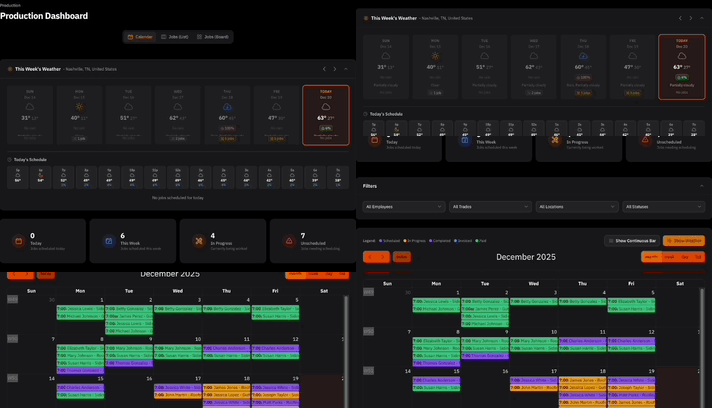
Calendars that flex with reality. A scalable operation can re-sequence production quickly when weather, supply, or crew availability shifts, instead of letting one disruption cascade into a week of confusion.
The common thread is this: the business stops depending on any one person's memory and starts depending on shared, reliable structure. That's what lets a roofing company add jobs, crews, and revenue without adding proportional chaos.
How Connected Systems and Roofing Software Make It Work
You can build a lot of this discipline manually — with rigorous spreadsheets, tight meetings, and sheer force of will. Many roofing companies do, for a while. But manual systems have a ceiling, and the larger you get, the more the cracks show. This is where purpose-built roofing software earns its place, because it does two things spreadsheets and whiteboards fundamentally can't: it connects everything, and it surfaces what matters automatically.
The goal isn't more software. Most roofing companies already have too many disconnected tools. The goal is a connected operating system that ties the pieces together. A platform like ContractorHUB was built specifically for this — by a founder who scaled roofing companies before he wrote a line of code — and it's worth using as a concrete example of what "connected" actually means.
It integrates the tools you already use instead of forcing you to abandon them. If your team lives in JobNimbus, AccuLynx, or RoofLink for their CRM, and your books are in QuickBooks, you don't want to rip all that out. The point of a central hub is to connect those systems — pulling lead, production, and financial data into one place — so you finally see the whole business without re-entering anything. That single move, going from scattered tools to one connected view, eliminates a huge share of the day-to-day chaos.
It gives you real-time financial and job visibility. When accounting data syncs automatically, you can see profitability and cash flow as it happens rather than reconstructing it weeks later. Marketing performance, lead sources, and conversion rates sit alongside the financials, so you can tell which channels are actually producing profitable jobs.
It builds accountability into the workflow. Clear roles, performance tracking, crew and field portals, and visible progress mean people own their work without the owner hovering. The system shows who's responsible and where things stand, which is exactly what takes the founder out of the dispatcher role.
It handles the operational details that quietly cause chaos. Features like a weather assistant that helps you adjust the production calendar around storms, inventory and fleet tracking so equipment is job-ready, and centralized SOPs and training so every crew works the same way — these are the unglamorous mechanics that, left untracked, turn into fire drills.
It does the administrative heavy lifting so you scale without adding overhead. The promise of a connected system is that you can grow jobs and revenue without proportionally growing your admin staff. The software absorbs the coordination load that would otherwise require another coordinator, another manager, another person whose whole job is chasing information.
The practical takeaway is straightforward: connected systems replace the founder's memory and the team's heroics with reliable, visible structure. That's what turns a chaotic growth phase into a controlled one.
Where to Go From Here
If any of this felt familiar — the 7 p.m. scheduling scramble, the job that lost money without anyone noticing, the nagging sense that you're the only one who can see the whole picture — the issue probably isn't your effort or your team. It's that your operation is still being run on systems built for a smaller company than the one you now have.
The first step doesn't require buying anything. It requires an honest look at how information actually flows through your business today. Ask yourself a few simple questions: Where does our data live, and do those systems talk to each other? Can I see job profitability in real time, or only after the fact? When something slips, do we catch it early or find out from an angry customer? Does the team know who owns what, or does everything route back to me?
The answers usually make the gaps obvious. Once you can see clearly where the chaos enters, you can decide whether to close those gaps with better process, better tools, or both.
If you want to see what running your roofing company from one connected view actually looks like, it's worth taking a closer look at how ContractorHUB ties it together. Either way, the move that matters most is the same: stop treating chaos as the price of growth, and start building the systems that let you grow without it.
Test Quote by Matt Parks


