It's 7:15 a.m. and your production manager is already on his third app. He pulls up the CRM to check which jobs closed yesterday, jumps to a spreadsheet to see who's scheduled, opens a texting app to confirm a crew, then digs through email to find the signed contract a customer swears they sent. By the time he's pieced the morning together, the first crew has already left the yard—half-briefed.
Nobody planned for the day to start this way. It's just what happens when a roofing company runs on six disconnected tools instead of one connected system. The cost isn't dramatic on any single morning—it's the slow drip of minutes, re-entered data, and dropped handoffs that quietly eats into your margins all year long. And because it never shows up as a line item, most owners never see the size of it.
That daily tool-switching is one of the most underestimated sources of roofing operational inefficiency. Here's why it happens, what it's costing you, and how to fix it.
Why Tool-Switching Plagues Roofing Companies Specifically
Roofing isn't a single, tidy workflow. One job touches sales, measurements, material orders, scheduling, crew dispatch, insurance documentation, inspections, invoicing, and follow-up reviews. Each of those functions tends to get its own tool, adopted at a different time, by a different person, to solve a different fire.
A few patterns make this worse in roofing than in most trades:
The business grew faster than the systems did. Most roofing companies start with a phone, a truck, and a notebook. Then comes a spreadsheet. Then a CRM because the spreadsheet broke. Then a separate measurement app, a separate accounting tool, a separate texting service. Nobody ever sat down and designed a system—it accreted one emergency at a time.
Roofing has too many handoffs. A lead becomes an inspection, becomes an estimate, becomes a signed job, becomes a material order, becomes a scheduled crew, becomes an invoice. Every handoff between tools is a place where information gets re-typed, lost, or delayed. The more tools, the more seams—and seams are where work falls through.
Field and office live in different worlds. Your crews are on roofs with phones; your office staff are at desks with browsers. When the tools don't talk, the office is always chasing the field for status, and the field is always waiting on the office for the next address. That gap is pure roofing operational inefficiency.
Insurance and documentation demands pile on. Storm and insurance work means photos, supplements, adjuster notes, and approvals scattered across email, camera rolls, and PDFs. Without a system that keeps it attached to the job, your team spends hours re-assembling a paper trail that should have been automatic.
The result is predictable: smart, capable people spending a real chunk of every day just moving information from one place to another instead of doing the work that actually grows the company.
The Hidden Cost of Ignoring the Problem
Because no single tool-switch feels expensive, this problem hides in plain sight. But add it up across a crew and a year, and the numbers get hard to ignore.
Wasted labor hours. If a project coordinator loses even 45 minutes a day reconciling data between tools, that's roughly four hours a week—over 200 hours a year for one person. Multiply that across your office staff and you're funding a part-time salary just to copy information between apps.
Slower cash cycles. When the signed contract lives in one place, the material order in another, and the invoice in a third, billing lags. Jobs get completed but not invoiced for days because someone has to chase down the documentation first. Slow invoicing is slow cash, and slow cash strangles a growing roofing business.
Dropped balls that cost real money. A missed measurement detail leads to a wrong material order. A scheduling conflict double-books a crew. A follow-up that never happens loses a five-star review or a referral. These aren't rounding errors—each one is a margin hit on a specific job.
No single source of truth. When five tools each hold a piece of the picture, nobody can answer simple questions confidently: How many jobs are in production right now? Which ones are stalled? What's our real backlog? Leaders end up making decisions on gut feel because the data is too fragmented to trust.
Accountability evaporates. When work is spread across disconnected tools, it's nearly impossible to see who dropped what. "I thought you ordered the shingles." "I texted you the address." With no shared record, problems become finger-pointing instead of fixes.
Onboarding gets brutal. Every new hire has to learn six logins, six interfaces, and the unwritten tribal knowledge of which tool to check for what. Good people get frustrated and slow to ramp.
The companies that ignore this don't usually fail dramatically. They just stay smaller, more stressed, and less profitable than they should be—capped by the friction of their own tooling.
What a Better System Actually Looks Like
The fix isn't "buy more software." Adding a seventh tool to solve the problem of six tools is how you got here. The goal is connected roofing workflow management—fewer places to look, with the right information flowing automatically between stages.
A well-run roofing operation has a few traits worth aiming for:
One job, one record. Everything about a job—contact info, photos, measurements, contract, material order, schedule, notes, invoice—lives attached to a single job record that everyone can see. No re-typing, no hunting.
Visibility from lead to paid. Leadership can open one screen and see the whole pipeline: what's sold, what's scheduled, what's in production, what's waiting to be invoiced. Roofing systems that surface this remove the guesswork from running the business.
Automatic handoffs. When a job is signed, the next steps trigger without someone manually copying data forward. The estimate flows into the work order; the work order flows into scheduling; completion flows into invoicing.
Field and office on the same page. Crews update job status from their phones, and the office sees it in real time. No more status-chasing calls. The address, the scope, and the photos are all in one place the crew can reach from the roof.
Built-in accountability. When tasks are assigned inside the system with clear owners and timestamps, it's obvious what's done and what's stuck—not as a blame tool, but so problems surface early enough to fix.
Documentation that organizes itself. Photos, supplements, and approvals attach to the job automatically, so the insurance paper trail builds itself instead of being reconstructed under deadline.
You don't need every one of these on day one. But each step toward consolidation removes a seam—and every seam removed is time and money back in the business.
How Connected Roofing Software Tools Close the Gap
This is where purpose-built roofing software tools earn their place. The difference between general business software and roofing-specific systems is that the latter is built around how roofing work actually flows—from inspection to supplement to crew to invoice—rather than forcing your team to bend a generic tool into shape.
Connected roofing business software solves the tool-switching problem in a few concrete ways:
It replaces the stack, not adds to it. Instead of a CRM, a scheduler, a measurement tool, a texting app, and a spreadsheet, a connected platform handles those functions in one environment. Fewer logins, fewer seams, fewer places for work to hide.
It keeps data entered once. A customer's information, a job's scope, a set of measurements—captured one time and reused everywhere downstream. That single change alone eliminates a huge share of the daily re-typing tax.
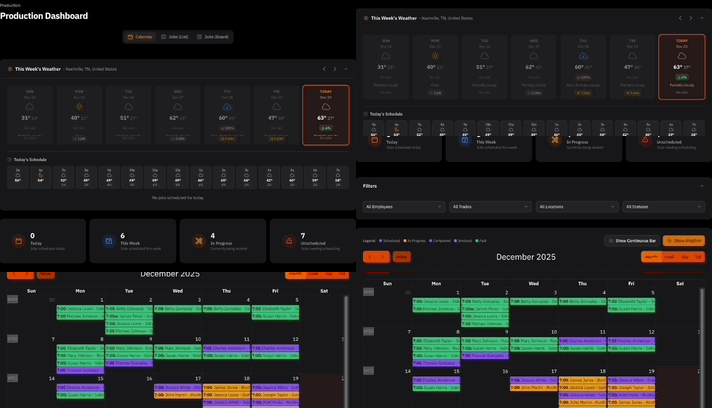
It makes the whole pipeline visible. Dashboards built for roofing show production status, backlog, and bottlenecks at a glance, so leaders manage from data instead of memory.
It connects the field and the office in real time. Mobile-first roofing workflow management means crews and coordinators are looking at the same job record, updated live—no relay, no lag.
It can integrate what you can't replace. For tools you're genuinely committed to—say, your accounting software—good roofing systems integrate rather than isolate, so even the pieces you keep talk to the rest.
The point isn't the technology for its own sake. It's that consolidating your tools turns those wasted morning hours into productive ones, tightens your cash cycle, and gives you back the visibility to actually run the company instead of constantly reconciling it.
How ContractorHUB Is Built to Remove the Seams
This is exactly the problem ContractorHUB was designed around. Rather than being one more app to add to the pile, it acts as a central operating system for the business—organizing People, Property, Process, Pipeline, and Performance in one connected environment, so information stops getting re-typed and re-chased between tools.
A few parts of the platform map directly to the friction points above:
It connects the tools you already use. ContractorHUB integrates with 40+ tools across CRM, accounting, HR, email, calendar, advertising, and phone tracking—so you can keep the systems your team likes and still see everything in one place. For the pieces you're ready to consolidate, it can replace several stack items outright, like data aggregators and certain CRMs.
One view from lead to paid. The Pipeline area tracks marketing, leads, sales, calls, and production so work moves cleanly from first contact to completed job—closing the handoff gaps where information normally gets dropped or delayed.
Real-time financials and performance. Synced accounting data and KPI dashboards mean leadership can answer "what's our backlog, what's stalled, what's profitable" from one screen instead of stitching together exports from five tools.
A Weather Assistant built for roofing. Weather alerts and scheduling automations help you protect your production calendar—handling a roofing-specific reality that generic business software simply ignores.
Recruiting and team management in the same system. Hiring—often run on spreadsheets, texts, and sticky notes—lives alongside employee performance and accountability tools, connected to the rest of your operation instead of stranded in a separate app.
The throughline is the same one this whole post is about: fewer tools, fewer seams, and a single place where the work actually lives. You can explore the full platform or see how it's built specifically for roofers.
Stop Paying the Tool-Switching Tax
The minutes lost between apps don't show up on any invoice, which is exactly why they're so easy to ignore. But they're real—measured in labor hours, slow cash, dropped jobs, and decisions made in the dark.
A good first step costs nothing: spend a week noticing how often your team switches tools to complete a single job, and how many times the same piece of information gets typed in twice. Map it out. The picture usually makes the problem—and the opportunity—obvious.
If the audit reveals what most roofing leaders find, it may be time to look at whether connected roofing software tools could replace the patchwork your business has outgrown. The goal isn't more technology. It's fewer seams, clearer visibility, and a team that spends its day on roofing instead of reconciling apps—which is exactly what ContractorHUB is built to deliver. If you're ready to see what running your whole operation from one place looks like, book a demo and we'll walk you through it.


