
Most roofing owners assume that more revenue means more breathing room. Then the opposite happens. The jobs keep closing, the crews keep rolling, the deposits keep landing — and somehow the business feels harder to run at $8M than it did at $3M. Production is slipping. Collections are aging out. Your project managers are drowning, and you're back in the truck putting out fires you thought you'd hired your way out of.
If that sounds familiar, you're not failing. You're scaling. And scaling roofing operations exposes problems that growth created but didn't announce. The same scrappy habits that got you to your first few million quietly become the bottleneck that caps the next few. This post breaks down why that happens, what it costs when you ignore it, and what a roofing company that's built to grow actually does differently.
Why This Problem Happens in Roofing Companies
Roofing is uniquely punishing to scale because the work is high-volume, weather-dependent, cash-intensive, and split across dozens of moving handoffs per job. A single re-roof touches the inspection, the estimate, the insurance supplement, material ordering, crew scheduling, the install, the final inspection, the invoice, and the collection. At ten jobs a month, one person can hold all of that in their head. At a hundred, nobody can — but most roofing companies never rebuild the system to match the volume.
Here's the core issue: early growth runs on people, not process. Your best estimator remembers which adjusters are slow. Your office manager knows which suppliers deliver late. Your production lead keeps the schedule in a notebook and a group text. That tribal knowledge is your operating system, and it works beautifully — until it doesn't scale, take a vacation, or quit.
A few roofing-specific dynamics make this worse:
Seasonality compresses everything. A storm hits and lead volume triples in a week. Companies that lean on memory and manual handoffs can't absorb the surge, so quality and follow-up collapse exactly when the revenue opportunity is biggest.
The cash cycle is brutal. Insurance jobs, supplements, deductibles, draws, and retainage mean money moves in fragments. Without tight tracking, profitable jobs quietly bleed margin and aging receivables pile up unnoticed.
Handoffs multiply faster than headcount. Every new crew, sales rep, and CSR adds communication lines. Five people have ten connections between them; fifteen people have over a hundred. Complexity doesn't grow with your team — it compounds.
This is the heart of roofing operational complexity: the business didn't get harder because you got worse at running it. It got harder because the volume outgrew the informal systems holding it together.
The Hidden Cost of Ignoring It
The danger with roofing growth challenges is that the symptoms look like normal busyness, so owners treat them as a staffing problem instead of a systems problem. They hire another coordinator, add another project manager, and the chaos absorbs the new person within a quarter. The real costs hide in plain sight:
Margin erosion you can't trace. When job costs live across texts, spreadsheets, and someone's memory, you find out a job lost money after it's closed — not while you could still fix it. Across a year of volume, a few points of untracked margin is a six-figure leak.
Slow collections and aging AR. Jobs get installed but not invoiced, or invoiced but not followed up on. The work is done; the money just sits there. Cash flow tightens even as revenue climbs, which is the single most disorienting part of scaling a roofing company.
Reputation drift. A missed callback, a crew that shows up on the wrong day, a homeowner who can't get a status update — at low volume these are rare. At high volume, with no system, they become routine, and your review average starts sliding right when referrals matter most.
Owner dependency. The most expensive cost is the one on your calendar. If growth means you're working more hours and making more decisions, you haven't built a company — you've built a job that pays better and stresses harder. That ceiling is real, and it's where most roofing companies stall.
Ignoring this doesn't keep things stable. It just defers the bill, and the bill gets larger with every additional crew and market you add.
What a Better System Actually Looks Like
Fixing this isn't about working harder or hiring a unicorn ops manager. It's about installing roofing systems that make the right behavior automatic and the current state visible. A roofing company built to scale tends to have four things in place.
Standardized workflows. Every job moves through the same defined stages, with clear ownership at each handoff. A lead doesn't "fall through the cracks" because there's a defined next step and a named owner for it. New hires get productive in weeks instead of months because the process isn't locked in a veteran's head.
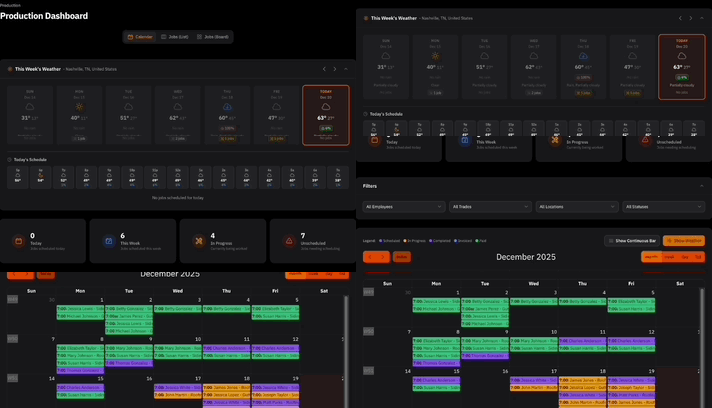
Real visibility. Leadership can answer "How many jobs are in production right now? What's our average days-to-collect? Which jobs are behind?" in seconds, not by calling three people. You manage by dashboard, not by gut and group text.
Built-in accountability. When a task is assigned, tracked, and visible, follow-through stops depending on who remembers. The system surfaces what's stalled — the supplement waiting on an adjuster, the invoice not sent, the inspection not scheduled — before it becomes a problem a customer notices.
Connected data. Sales, production, and accounting see the same job record. The estimate, the change orders, the material costs, and the payments live together, so margin is visible in real time instead of reconstructed after the fact.
The goal isn't more control for its own sake. It's removing the friction and guesswork so your team executes consistently whether you're doing 10 jobs a month or 100 — and whether or not you're personally watching.
How Roofing Software and Connected Systems Help
You can build pieces of this with disciplined spreadsheets and rigorous habits, and plenty of companies start there. But spreadsheets don't enforce a workflow, don't update themselves, and don't tell you what's slipping. That's where purpose-built roofing management software earns its place: it turns the four pillars above from things you have to police into things the system maintains by default.
In practice, connected roofing software does a few things manual processes can't:
It enforces the workflow. A job can't skip from "sold" to "scheduled" without the steps in between, so handoffs happen the same way every time, regardless of who's involved.
It centralizes the job record. Photos, measurements, estimates, supplements, scheduling, and invoices live in one place instead of scattered across apps and inboxes — so nobody's hunting for the latest version.
It makes status self-reporting. Instead of chasing updates, leadership sees production, AR, and pipeline live. Problems surface early because the data is current, not reconstructed weekly.
It scales communication. Automated homeowner updates, internal notifications, and assigned tasks keep everyone aligned without adding another coordinator to ferry information between departments.
The point isn't the software itself — it's what it removes: the memory-dependence, the manual chasing, and the blind spots that make scaling roofing operations feel like it's fighting you. Done right, your systems carry more of the operational weight, so adding revenue stops meaning adding chaos.
Where to Start
If the gap between your revenue and your operational sanity is widening, that gap is information, not a verdict. It's telling you the business has outgrown the systems running it — which is a good problem, and a fixable one.
A practical first move: pick one job that recently went sideways and trace it end to end. Where did it stall? Who had to remember something for it to move? Where did the margin or the timeline leak? You'll usually find the same two or three failure points repeating across jobs, and those are exactly where better workflows, clearer accountability, and connected roofing software pay for themselves fastest.
Take an honest look at how your operation runs today — what lives in someone's head, what depends on follow-up that may or may not happen, and what you genuinely can't see in real time. If more revenue is quietly making your company harder to run, the systems underneath it are worth evaluating before the next growth surge forces the issue for you.
ContractorHUB was built for exactly this moment — to give growing roofing companies the workflows, visibility, and connected job data that keep operations under control as volume climbs. See it in action — book a demo of ContractorHUB and find out what your operation looks like when your systems carry the weight instead of you.


