
When people talk about “tech debt,” they usually mean software engineering problems: outdated code, aging infrastructure, or systems that became difficult to maintain over time.
Roofing companies experience their own version of tech debt, but it rarely starts with code. More often, it develops operationally.
In practice, contractor tech debt is the long-term operational cost created by years of reactive decisions, disconnected systems, manual workarounds, and processes that evolved faster than the business infrastructure supporting them.
It rarely announces itself clearly. More often, it shows up gradually:
production teams operating from different information than sales,
office staff manually reconciling reports every week,
estimators following slightly different workflows,
communication spread across too many systems,
or critical operational knowledge living inside a handful of employees rather than inside standardized process.
None of these problems are unusual. In many cases, they are a byproduct of growth.
Most roofing companies build operations around the immediate demands in front of them. A new tool gets added to solve one problem. A spreadsheet gets introduced to bridge another gap. An experienced employee develops a process that works, so the organization adapts around it.
Over time, those decisions accumulate into an operational environment that functions well enough day-to-day, but becomes increasingly difficult to scale cleanly. The challenge is that operational complexity compounds faster than most organizations realize.
Roofing Tech Debt Looks Different Than Traditional Software Debt
In software engineering, technical debt often refers to shortcuts in development that create future maintenance costs. In roofing, tech debt is more operational than technical. It develops when business complexity outpaces operational infrastructure.
That can happen in different ways:
Sometimes smaller organizations adopt workflows designed for companies three times their size. They layer on disconnected systems, excessive process, and complicated handoffs before the business has the operational maturity to support them.
Other times, larger companies continue operating on workflows established years earlier when the organization was significantly smaller. Processes that worked when one office manager coordinated everything manually begin breaking down across multiple departments, production teams, locations, or service divisions.
Both situations create friction. Just in different forms.One company becomes overly complicated too early. The other becomes operationally outdated without realizing it.
In both cases, the underlying issue is the same: the systems supporting the business no longer match the complexity of the organization itself.
One of the Clearest Warning Signs: People Owning Process
One of the most common indicators of operational tech debt is when critical workflows become dependent on specific individuals instead of standardized systems.
Most roofing companies have key employees who hold operations together:
the production coordinator who knows how every exception gets handled,
the office manager who manually fixes reporting inconsistencies,
the dispatcher who understands the “real” scheduling workflow,
or the estimator who trained everyone differently over time.
Initially, these people feel indispensable because they are experienced and capable.
The problem is that organizations quietly begin depending on individual memory and informal process instead of operational consistency.
That creates several long-term issues:
onboarding becomes difficult,
accountability becomes inconsistent,
process varies between departments,
and leadership loses visibility into how work is actually being executed.
If workflows cannot be consistently taught, measured, repeated, and enforced across the organization, the business is likely carrying operational debt that becomes more expensive as the company grows.
How Roofing Companies Accidentally Create Fragile Systems
Another common pattern is what many operators would recognize as “tape-and-glue” infrastructure.
Over time, roofing companies naturally accumulate systems:
CRM platforms,
estimating tools,
production workflows,
accounting software,
spreadsheets,
communication apps,
reporting exports,
and custom integrations connecting them all together.
Individually, none of these tools are necessarily wrong. The problem is the way they work (or don't work) together.
Information gets entered multiple times. Teams maintain separate spreadsheets because they do not fully trust system reporting. Statuses mean different things across departments. Managers spend time validating data instead of acting on it.
At a certain point, the business starts creating administrative overhead simply to maintain operational continuity.
Diagnosing Operational Tech Debt Inside Your Organization
One of the challenges with contractor tech debt is that it often becomes normalized internally. Teams adapt around friction gradually enough that leadership may not immediately recognize how much operational inefficiency has accumulated.
A few questions can help identify whether operational debt is starting to affect the business:
Do teams trust reporting without manual verification?
If leadership meetings regularly involve validating numbers before discussing performance, there is likely fragmentation somewhere in the operational workflow.
Are employees maintaining parallel systems?
When teams rely on spreadsheets, side notes, or manual trackers outside core systems, it often signals that operational visibility is incomplete or inconsistent.
Does operational continuity depend heavily on certain individuals?
If onboarding requires extensive shadowing or processes break down when key employees are unavailable, institutional knowledge may be replacing standardized process.
Is communication fragmented across departments?
Misalignment between sales, production, supplements, service, and accounting is often one of the earliest indicators that workflows are not scaling cleanly.
Is administrative overhead increasing faster than operational efficiency?
Many organizations unintentionally add labor to compensate for process inconsistency rather than improving the systems underneath it.
These issues are rarely caused by a single bad platform. More often, they result from years of operational adaptation without intentional standardization.
Modernization Should Reduce Friction, Not Increase It
One of the biggest mistakes companies make when addressing operational debt is attempting to overhaul everything at once. In reality, sustainable operational modernization usually happens incrementally.
The healthiest transitions tend to focus first on areas where friction is already creating measurable cost:
duplicated entry,
reporting inconsistency,
communication breakdowns,
onboarding challenges,
production bottlenecks,
or lack of visibility between departments.
From there, organizations can begin improving operational consistency by:
centralizing critical operational data,
standardizing core workflows,
simplifying unnecessary process,
reducing duplicated effort,
and creating trainable, enforceable SOPs.
The goal is not to eliminate flexibility. Roofing operations will always require adaptability.
The goal is to create operational clarity that scales with the business instead of relying on increasingly fragile workarounds.
Why We Built ContractorHUB Around Operational Transition
This reality is one of the main reasons we built ContractorHUB the way we did.
Most roofing companies cannot rebuild their operational infrastructure overnight, nor should they try to. Effective modernization has to account for organizational stage, team adoption, existing workflows, and the reality that the business still has to operate while improvements are being made.
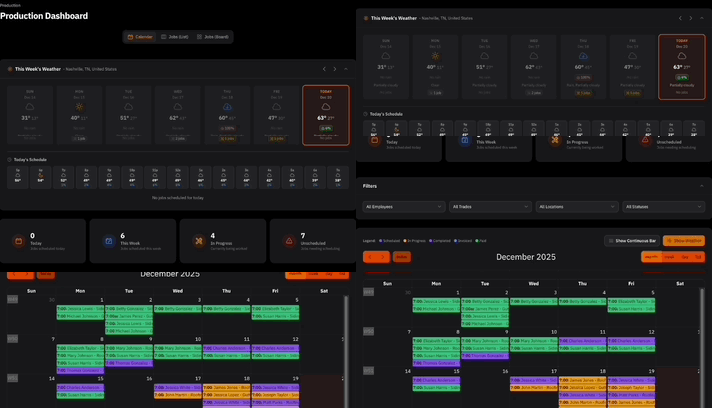
Instead of forcing companies into rigid operational models, ContractorHUB was designed to help organizations centralize operational visibility, standardize workflows, improve communication, and create scalable process at a pace that makes sense for the business.
For some companies, that starts with improving reporting reliability. For others, it means reducing duplicated administrative work, improving production visibility, or creating enforceable SOPs that are no longer dependent on tribal knowledge.
The objective is not simply to add more software—it's to help roofing companies build operational systems capable of supporting long-term growth without becoming dependent on manual coordination, fragmented communication, or organizational heroics to function effectively.
If you’re ready to explore how ContractorHUB can fit into your operations, feel free to Get a Demo. We’re here to assist you in making incremental, impactful changes to reduce tech debt and enhance operational efficiency.


