
Most roofing companies don’t realize they have a systems problem until growth starts creating chaos.
At first, disconnected roofing systems seem manageable. One team uses spreadsheets. Another relies on texts and phone calls. Sales tracks leads in one platform, production schedules jobs somewhere else, and accounting pulls numbers manually at the end of the month. Everyone adapts.
Until they can’t.
As roofing businesses grow, disconnected systems quietly create operational drag that impacts profitability, customer experience, accountability, and team performance. Jobs fall through cracks. Supplements get delayed. Crews arrive without updated information. Sales and production blame each other. Owners spend more time chasing answers than leading the business.
The real issue isn’t simply “bad communication.” It’s a lack of operational visibility across the company.
For many roofing business owners, this becomes one of the biggest hidden costs limiting scalable growth.
In this article, we’ll break down why disconnected roofing systems happen, the operational costs they create, and how connected roofing management systems and roofing software integrations can help companies regain control without adding unnecessary complexity.
Why Disconnected Roofing Systems Happen in Growing Roofing Companies
Disconnected roofing systems rarely happen overnight.
They usually develop gradually as a roofing company grows faster than its processes.
A roofing business might start with:
A CRM for leads
QuickBooks for accounting
Google Sheets for production tracking
Group texts for crews
Email for supplements
Separate apps for material ordering
Manual reporting for ownership
Individually, none of these tools seem problematic. The issue is that they often don’t communicate with each other.
As more employees, crews, and jobs enter the system, information becomes fragmented across departments.
Roofing Companies Often Build Processes Around Immediate Needs
Roofing is operationally intense. Owners constantly solve urgent problems:
Storm volume spikes
Scheduling changes
Insurance delays
Material shortages
Labor coordination
Customer communication
Cash flow timing
Because of this, many companies implement systems reactively instead of strategically.
A sales manager chooses one tool. Production creates another workflow. Accounting builds its own reporting process. Over time, the company ends up operating in silos.
This creates a business where critical information lives in too many places.
Rapid Growth Magnifies Operational Gaps
A roofing company doing $2 million annually can sometimes survive disconnected processes through sheer effort.
At $10 million or $20 million, those same gaps become expensive.
Why?
Because scale increases operational dependency between departments.
Sales depends on accurate production updates. Production depends on supplements being approved. Accounting depends on completed paperwork. Leadership depends on reliable numbers.
When systems are disconnected, every department loses visibility into what’s happening upstream and downstream.
That lack of roofing operational visibility creates friction everywhere.
The Hidden Cost of Ignoring Disconnected Roofing Systems
Most owners notice the symptoms before they identify the root cause.
They feel like:
Constant firefighting
Repeated mistakes
Team confusion
Slow job cycles
Unreliable reporting
Customer complaints
Production bottlenecks
But these problems are often connected to one core issue: fragmented operational systems.
Lost Time Across Every Department
One of the largest hidden costs is wasted administrative time.
In disconnected environments, employees spend hours:
Re-entering data
Searching for updates
Calling other departments
Verifying job statuses
Updating spreadsheets manually
Correcting inconsistent information
For example, production may update a job completion date in one system while accounting never receives the update. That delay can hold invoicing for days or weeks.
Multiply these inefficiencies across hundreds of jobs annually, and the operational loss becomes massive.
Reduced Accountability
Disconnected systems make accountability difficult because no one has a complete picture.
When information is fragmented:
Sales blames production
Production blames supplements
Office staff blames missing paperwork
Owners struggle to identify operational breakdowns
Without centralized roofing data visibility, it becomes difficult to answer simple operational questions:
Where is this job stuck?
Who owns the next step?
Why hasn’t this invoice been sent?
Which crews are most efficient?
What stage is slowing cash flow?
The result is reactive management instead of proactive leadership.
Slower Cash Flow
Cash flow is one of the most overlooked casualties of disconnected roofing systems.
Many roofing companies unintentionally delay revenue because operational handoffs are inconsistent.
Common examples include:
Incomplete documentation delaying supplements
Missing completion photos slowing invoicing
Poor communication causing inspection delays
Accounting waiting on production confirmations
Untracked change orders creating payment disputes
When departments operate independently, revenue gets trapped between workflow gaps.
Even highly profitable roofing companies can experience cash flow stress when operational systems are disconnected.
Poor Customer Experience
Customers experience operational disconnects immediately.
They notice when:
Office staff lacks job updates
Crews arrive without information
Appointment details change unexpectedly
Multiple employees ask the same questions
Communication feels inconsistent
Modern homeowners expect professionalism and coordination.
Disconnected roofing management systems create the opposite experience: confusion.
That confusion damages referrals, reviews, and long-term reputation.
Leadership Loses Visibility
Perhaps the most dangerous cost is what owners can’t see.
Many roofing leaders operate without reliable real-time metrics because their reporting is fragmented.
They may struggle to confidently answer:
Which jobs are stalled?
What is average cycle time?
Which crews are most profitable?
Where are supplements getting delayed?
What’s the true backlog status?
Which sales reps create the most production issues?
Without strong roofing operational visibility, leadership decisions become reactive and based on assumptions instead of data.
What a Better Roofing System Looks Like
Solving disconnected operations does not mean adding more software.
It means creating connected workflows with shared visibility across the business.
The strongest roofing companies build systems where information flows clearly between departments.
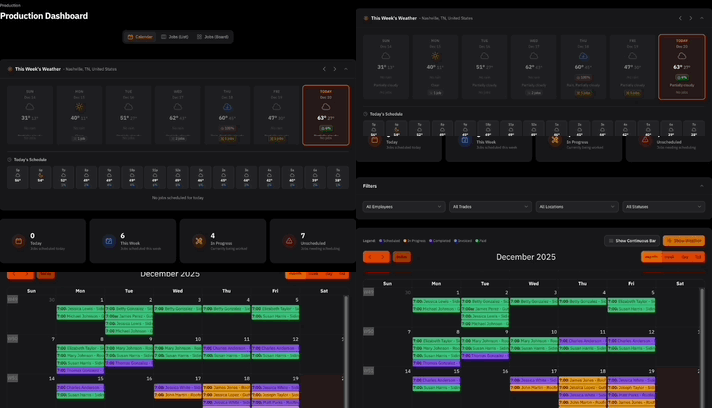
Centralized Job Visibility
Every department should be able to access accurate, real-time job information.
That includes:
Sales status
Production scheduling
Material delivery
Supplement progress
Customer communication
Invoicing status
Completion documentation
When teams work from the same operational view, confusion decreases dramatically.
Defined Ownership at Every Stage
Connected systems improve accountability because responsibilities become visible.
Instead of vague handoffs, each stage has clear ownership:
Sales owns contract completion
Production owns scheduling
Supplements owns carrier communication
Accounting owns invoicing
Everyone knows what is complete, what is pending, and what requires action.
Standardized Processes
Growing roofing companies often suffer from “tribal knowledge.”
Critical processes exist only in employees’ heads.
Connected roofing management systems help standardize workflows so operations become repeatable and scalable.
This is especially important when onboarding new office staff, project managers, or production coordinators.
Real-Time Operational Reporting
Better systems allow owners to monitor operational performance without manually gathering updates.
Key metrics become visible across the organization, including:
Job cycle times
Production delays
Supplement turnaround
Revenue pacing
Backlog status
Crew performance
Gross profit trends
This level of roofing data visibility helps leaders identify bottlenecks before they become expensive problems.
How Roofing Software Integrations Help Create Connected Operations
Technology alone does not solve operational issues.
But well-connected systems can eliminate many of the friction points that slow roofing companies down.
The goal is not simply “more software.” The goal is alignment.
Roofing Software Integrations Reduce Manual Work
One of the biggest advantages of roofing software integrations is eliminating duplicate effort.
When systems communicate properly:
Sales data flows into production
Production updates sync with invoicing
Customer information remains consistent
Photos and documents stay attached to jobs
Status changes become visible company-wide
This reduces administrative overhead while improving accuracy.
Connected Systems Improve Operational Visibility
Strong roofing operational visibility allows owners to manage proactively instead of reactively.
Instead of waiting for problems to surface through complaints or delays, leadership can identify issues early.
For example:
Jobs stalled in supplements become visible immediately
Delayed production schedules can be monitored in real time
Missing documentation gets flagged before invoicing delays occur
Workflow bottlenecks become measurable
Visibility creates control.
And control becomes increasingly important as roofing companies scale.
Better Systems Create Better Accountability
When workflows are connected, accountability becomes objective instead of emotional.
Teams no longer rely on memory, texts, or assumptions.
The system itself provides clarity around:
Status updates
Task ownership
Pending approvals
Missed deadlines
Operational bottlenecks
This reduces internal friction while improving execution consistency.
Connected Roofing Management Systems Support Scalable Growth
Many roofing companies hit operational ceilings long before they hit market ceilings.
They have demand.
They have sales.
But operational complexity prevents sustainable scaling.
Connected roofing management systems help companies grow without multiplying chaos.
Instead of adding more administrative layers, businesses can improve coordination, visibility, and process efficiency across existing teams.
That operational leverage becomes a major competitive advantage.
Evaluate the Cost of Your Current Systems
Most roofing companies don’t struggle because their teams lack effort.
They struggle because disconnected roofing systems create invisible operational friction that compounds over time.
The longer those gaps remain unresolved, the more they impact:
Profitability
Cash flow
Team performance
Customer experience
Leadership visibility
Scalable growth
The solution is not necessarily replacing every tool your company uses.
It’s evaluating whether your systems create clarity or confusion.
Do your departments operate from shared information?
Can leadership see operational bottlenecks in real time?
Are workflows connected or dependent on manual follow-up?
The roofing companies that scale successfully are often the ones that prioritize visibility, accountability, and operational alignment early.
Taking a closer look at your current processes, workflows, and roofing software integrations may reveal opportunities to simplify operations, reduce friction, and build a stronger foundation for growth.


