
Contractors don't sit down and decide to run the business on six different apps. It just happens.
You get a CRM to keep track of leads, QuickBooks because your accountant asked for it, a scheduling tool once the whiteboard stopped keeping up, a spreadsheet for job costs, one app for texting customers, and something else for payroll. Every one of them made sense the day you bought it. Put together, they're the reason nobody in your office can give you a straight answer about how the business is actually doing.
The real cost of running on disconnected business systems is more than the stack of monthly subscriptions. It's costs from wasted time, confusion, misinformation, and more. Every number you pull comes with a caveat, and every real decision waits on somebody lining up two screens by hand.
What disconnected systems actually cost you
The cost shows up in a few places: the hours your team burns reconciling tools, the decisions you make on numbers that turned out to be wrong, and the work that slips through the cracks between one app and the next.
Say a job closes in your CRM. The salesperson marks it sold, but accounting doesn't see it until someone keys it in again, so for a week your pipeline says one thing and your books say another. Or a customer's number gets updated in the scheduling app but not the CRM, so the reminder text goes to an old line and the crew shows up to an empty driveway. None of these are disasters on their own. Together they add up to an office that runs on double-entry and second-guessing.
Why it gets worse as you grow
At two crews, you're the integration. You hold the whole picture in your head and patch the gaps by remembering things. That works right up until it doesn't. Add crews and office staff, and the number of places your data can disagree grows faster than your team does. The gaps you used to catch start slipping past, and you spend your day being the human bridge between systems that won't talk to each other. That's a big part of how owners end up stuck in the weeds instead of running the company.
How to find what your tool sprawl is costing
You can size this up in an afternoon. You're not after a precise dollar figure, just an honest picture of where the friction is.
List every app and spreadsheet the business runs on, and what each one is the "source of truth" for.
Mark every place the same information gets entered in more than one system. Those are your double-entry points.
Time how long month-end takes, specifically the part where someone reconciles two tools by hand.
Write down the questions you can't answer in under a minute: true job cost, real pipeline value, which crew is actually most profitable. Those are the questions your disconnected systems are hiding from you.
A lot of owners are surprised by two things: how high the double-entry count is, and how long the can't-answer-quickly list gets. That list is the real cost, and it's usually bigger than the software bill.
What to actually do about it
You don't have to rip everything out at once. Start where the disagreement costs you the most, which for most contractors is the gap between the CRM, the accounting, and the job-cost numbers, since that's where money hides.
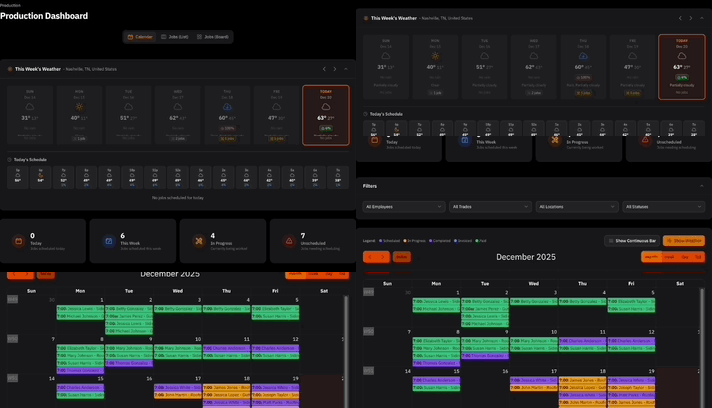
Some of that you can close with real integrations between the tools you already have. Some contractors go further and move the core of the business onto a single system like ContractorHUB, so the pipeline, the job costs, and the books all pull from the same place instead of arguing. Either way, the point isn't fewer logins for their own sake. It's one set of numbers your whole team can trust.
If you're not sure this is a problem for you yet, run the four-step check above. Count your double-entry points and the questions you can't answer in a minute, and you'll know pretty quickly whether your systems are costing you more than you thought. If you'd like to see what one connected system would look like for your business, you can book a walkthrough here.


