
Most roofing companies don't struggle with revenue — they face challenges with spending awareness. Surprisingly, "roofing overspending" is a common issue that's often overlooked. By understanding where the leaks occur, businesses can retain more of their hard-earned money. Let’s delve into the top areas where roofing companies inadvertently overspend.
1. Labor costs without enough visibility
Labor is your largest line item, and it's also the easiest place to lose money without a clear paper trail. Overtime creep is one of the most common culprits — when crew hours edge past 40 without a documented reason, payroll costs jump quickly and often go unquestioned.
But the subtler issue is unbillable time. Drive time to job sites, crew waiting on material deliveries, or duplicate dispatches from poor scheduling — none of it shows up in your estimates, but all of it shows up in your actual costs. According to the National Roofing Contractors Association, labor accounts for roughly 30–40% of total project costs on most residential and commercial roofing jobs, making it the single highest-leverage area to control.
High turnover compounds the problem. Replacing a skilled roofer can cost anywhere from $3,000 to $7,000 once you factor in recruiting, onboarding, and reduced output during ramp-up — often multiple times a year on larger crews.
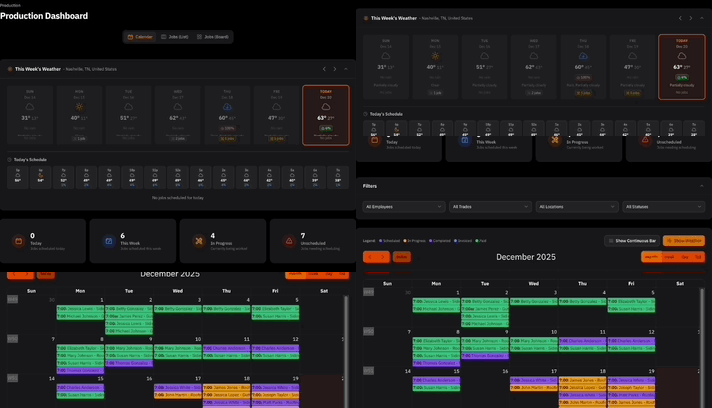
ContractorHUB's time tracking and crew scheduling tools give you a real-time view of where hours are going on each job, making it easier to catch overtime patterns and unbillable time before they stack up.
What to do
Start with accurate time tracking tied to individual jobs, not just a total weekly hours report. Once you can see labor by project, patterns surface fast — and you'll have the data to make scheduling decisions based on actual crew utilization rather than habit.
2. Fleet and vehicle expenses that add up in the background
Trucks are working tools, but they're also one of the quietest drains on a roofing operation's margins. Inefficient routing burns fuel. For a company running five or more trucks, even a few extra miles per vehicle per day can add up to thousands of dollars annually — and that's before accounting for deferred maintenance turning minor issues into major repairs.
Underutilized vehicles are another blind spot. If you're carrying insurance and registration costs on trucks that aren't consistently deployed, you're paying for capacity you're not using. A periodic fleet audit — looking at utilization rates, not just mileage — can surface vehicles worth reconsidering.
Fleet insurance is also worth a yearly review. Contractor fleets frequently end up over-insured on older vehicles and under-insured on newer ones, simply because policies aren't revisited when the fleet changes.
What to do
Build a basic routing review into your weekly dispatch process. Even batching job stops more intentionally using existing tools can meaningfully cut fuel costs. Then set a calendar reminder to review fleet insurance and vehicle utilization every 12 months.
3. Tools and equipment you can't fully account for
Tool loss and theft are real costs in roofing — but the less dramatic problem of not knowing what you own is often just as expensive. Without an inventory system, it's easy to order duplicate tools you already have somewhere on a job site, or to keep renting specialty equipment you could have owned outright at a lower total cost by now.
The rent vs. own question deserves more careful analysis than most contractors apply to it. For tools used daily, ownership typically pays off within a year. For specialty equipment deployed a few times a season, renting usually wins. The problem is that most companies make this call based on habit, not data.
ContractorHUB tracks equipment and materials by job, so you can see what's deployed, what's idle, and what hasn't come back — giving you the visibility to make smarter inventory decisions over time.
What to do
Build a simple inventory list, even if it's just a spreadsheet to start. Once you know what you own and how often it's being used, the rent vs. own decisions become much cleaner — and you stop paying for things you already have.
4. Estimates that aren't connected to real job cost data
If your estimates are built on memory, gut feel, or rough industry averages rather than your own historical job data, you're likely underpricing some work and overpricing other work. Both hurt you: underpricing squeezes margins you needed, overpricing costs you bids you should have won.
Job costing closes that loop. When you systematically track actual labor, materials, and equipment costs per project and compare them to your original estimates, clear patterns emerge. Maybe your flat-roof jobs consistently run 15% over on labor. Maybe a certain crew is highly efficient on residential but slower on commercial. You won't know without the data — and without knowing, you can't price accurately.
ContractorHUB's job costing feature connects estimated and actual costs in real time, so you can see where your bids are running tight and adjust future estimates accordingly.
What to do
Start tracking estimated vs. actual costs on every job, even if you're doing it manually at first. After 10–15 jobs, you'll have enough data to meaningfully improve your estimating accuracy — and that compounds into better margins on every bid you write going forward.
5. The compounding effect of small leaks
None of these issues feels catastrophic in isolation. An extra hour of overtime here, a missed maintenance window there, a tool that never came back from a job site — each one is easy to absorb in the moment. The problem is that small leaks across labor, fleet, and equipment don't stay small when you run the math across a full year.
For a roofing company doing $10M in revenue, consistent waste across these five categories can represent $30,000 to $80,000 in unnecessary annual spend — money that would otherwise fall to the bottom line or fund equipment upgrades, additional crews, or owner distributions.
The companies that protect their margins long-term aren't necessarily the ones with the most revenue. They're the ones with enough visibility into their costs to catch waste early, before it becomes a habit.
Where to start
A monthly cost audit — even a simple review comparing estimated to actual across your last 10 jobs — is enough to surface the biggest leaks. Job costing software makes this automatic, but the discipline matters more than the tool you use to track it.
Want to see where your money is actually going?
ContractorHUB helps contractors track job costs, manage crews, and get visibility into the numbers that matter — before they become a problem. Request a demo. It takes about 45 minutes to walk through it.


