

One of the most common questions roofing business owners ask is:
“What should my profit margin actually be?”
Should your net margin be 10%? 15%? 20%? More?
The answer depends on the type of roofing work you perform, your business model, and how efficiently you run your operation. A residential retail roofing company has different margin expectations than a commercial roofing contractor or an insurance restoration business.
Understanding the difference between gross margin and net margin—and knowing what healthy benchmarks look like—is one of the simplest ways to evaluate the financial health of your roofing business.
Gross Margin vs. Net Margin
Before looking at benchmarks, it’s important to understand what each metric measures.
Gross Margin
Gross margin is what’s left after subtracting the direct costs of completing a job, such as:
Materials
Labor
Subcontractors
Equipment directly tied to production
This tells you how profitable each roofing project is before accounting for overhead.
Net Margin
Net margin measures what’s left after every business expense has been paid, including:
Office salaries
Marketing
Insurance
Rent
Vehicles
Software
Administrative expenses
Taxes and other operating costs
Net margin ultimately reflects how much profit your company keeps.
Healthy Profit Margins for Residential Roofing Companies
For a residential retail roofing contractor, these are strong targets.
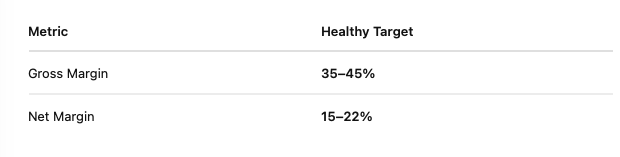
Many successful roofing companies operate comfortably around a 40% gross margin.
A gross margin closer to 35% can still produce an excellent business—as long as fixed expenses are well controlled.
The more efficiently your company operates, the more of that gross profit flows to the bottom line.
What Does an Elite Roofing Business Look Like?
Once your company consistently reaches 20% or greater net profit, you’re operating at an elite level.
That level of profitability rarely happens by accident.
It usually means you’ve built systems that allow the business to operate efficiently without relying on constant owner involvement.
Elite roofing companies typically have:
Standardized operating procedures
Accurate financial reporting
Clear accountability across departments
Efficient production scheduling
Consistent sales processes
Strong cost controls
Reliable performance metrics
In other words, the business is being managed by systems—not by firefighting every day.
Insurance Roofing Margins
Roofing companies focused on insurance restoration may see higher gross margins than residential retail contractors.
Insurance work often creates opportunities for additional revenue through supplements and detailed estimating, allowing some projects to generate stronger overall profitability.
However, insurance work also introduces operational complexity, making accurate job costing and financial tracking even more important.
Commercial Roofing Margins
Commercial roofing typically follows a different margin profile.
Many commercial contractors target approximately:
35% gross margin
15% net margin
Commercial projects often involve larger contract values but more competitive pricing, resulting in lower percentage margins than residential work.
Why Revenue Doesn’t Tell the Whole Story
A roofing company can generate millions in annual revenue while keeping very little profit.
That’s why focusing solely on sales growth can be misleading.
Healthy businesses continually monitor metrics like:
Gross margin
Net margin
Close rate
Average job size
Marketing ROI
Labor efficiency
Production costs
Together, these numbers tell the real story about how efficiently the business operates.
How ContractorHUB Helps Roofing Companies Improve Profit Margins
Knowing your margins is only the first step.
The real challenge is understanding why margins fluctuate and where profitability is leaking.
ContractorHUB gives roofing companies a complete operational view by connecting financial data, sales performance, production, marketing, and operational metrics into one AI-native platform.
Instead of manually pulling reports from multiple systems, business owners can quickly identify the drivers affecting profitability—from rising production costs to declining close rates or underperforming marketing channels.
With better visibility comes better decisions—and better decisions lead to stronger margins.
Final Thoughts
While every roofing business is different, these benchmarks provide a solid target:
Residential Retail: 35–45% gross margin, 15–22% net margin
Insurance Roofing: Often higher gross margins depending on supplements and estimating
Commercial Roofing: Around 35% gross margin and 15% net margin
Remember that profit isn’t just about charging more. It’s about building efficient processes, controlling costs, and making informed decisions using accurate business data.
The companies with the healthiest margins aren’t simply working harder—they’re operating smarter.
Ready to See How Your Business Compares?
Curious whether your margins are where they should be?
Get a Demo to learn how ContractorHUB helps roofing companies track the metrics that matter and turn insights into action.


