
You closed more jobs this year than last. The crews are busier, the phones ring more, and the revenue line is climbing. So why does running the company feel harder than it did when you were smaller?
Most roofing owners hit a wall that has nothing to do with sales. It's a decision problem. As the business grows, the number of choices you have to make every day multiplies — which crew to send where, whether to chase a slow-paying customer, why margins on last month's tear-offs came in thin, which sales rep is actually closing versus just running appointments. The information that would answer those questions exists. It's just scattered across a CRM, a spreadsheet, your project manager's head, three text threads, and a stack of supplier invoices on someone's desk.
That gap — between the data your company generates and the decisions you can actually make with it — is the operational problem behind almost every "we're growing but it's chaos" story in roofing. This is where AI for roofing companies is starting to change the game, not by replacing your judgment, but by finally putting the right information in front of you at the right moment.
Why This Problem Hits Roofing Companies So Hard
Roofing is uniquely good at generating disconnected information. Think about everything that touches a single job: the inbound lead, the inspection photos, the measurement report, the estimate, the material order, the crew schedule, the change orders, the final invoice, the warranty registration. Each of those typically lives in a different place, and each handoff is a chance for detail to get lost.
A few things make this worse in roofing specifically:
The work happens in the field, not at a desk. Your most valuable real-time information — what the crew actually found when they tore off the old shingles, how the customer reacted to the upsell, whether the job ran long — lives with people who are on a roof, not entering data into a system.
Margins swing job to job. Unlike a business with predictable unit economics, every roof is a little different. Pitch, layers, decking condition, and access all move your cost. If you can't see margin at the job level, you're flying blind on the metric that actually determines whether growth is making you money or just making you tired.
Seasonality and weather compress everything. When storm season hits, you don't have time to dig through reports. You're making rapid calls about scheduling, staffing, and which leads to prioritize — usually on gut feel, because the data isn't fast enough to help.
The result is that most growing roofing companies are running on a founder's intuition that worked great at $2M in revenue and quietly stops scaling somewhere north of that. The owner becomes the bottleneck because they're the only one who can hold the whole picture in their head.
The Hidden Cost of Flying Blind
The danger here isn't a single catastrophic mistake. It's the slow accumulation of decisions made with incomplete information, each one a little off, compounding over a season.
Consider what poor roofing operational visibility actually costs:
Margin erosion you don't catch until it's too late. If you only see profitability when the books close at month-end, you've already run thirty more jobs at the same broken pricing or with the same crew inefficiency. By the time the number shows up, the damage is done.
Leads that quietly die. A rep forgets to follow up. A bid sits unsent for four days. Nobody notices because nobody's watching the pipeline in aggregate — they're watching their own piece of it. Industry after industry shows that response speed drives close rates, and roofing is no exception. Slow follow-up is revenue walking out the door, silently.
Your best people stuck doing detective work. When the information isn't centralized, your office manager spends mornings calling crews to find out what happened on yesterday's jobs, and your sales manager rebuilds a pipeline report by hand every Monday. That's expensive labor spent reassembling information the business already had.
Accountability that's impossible to enforce. You can't hold a crew lead or a sales rep accountable to numbers nobody can see. Without shared visibility, every performance conversation becomes a debate about whose version of events is right.
None of these show up as a line item. They show up as a vague sense that the company should be more profitable than it is, and that you're working harder to run it than you should have to.
What a Better System Actually Looks Like
The fix isn't more software for its own sake. It's connection and visibility. A roofing operation makes better decisions when four things are true.
One source of truth. Every job, lead, and customer interaction lives in one place, so nobody is reconciling three versions of reality. When the field updates a job, the office sees it immediately.
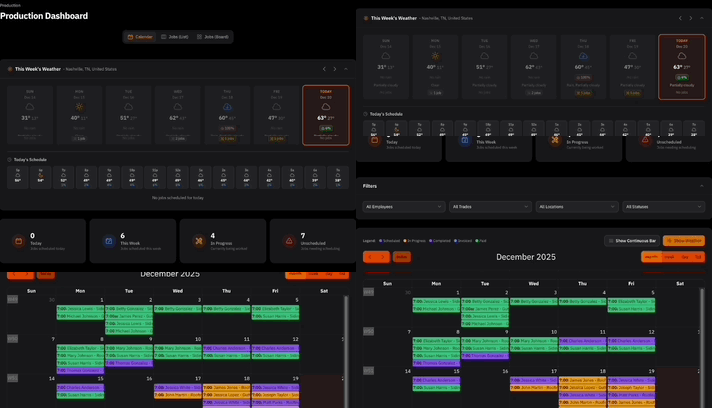
Real-time visibility instead of month-end autopsies. You can see how the business is performing today — pipeline, scheduled revenue, job-level margin, crew productivity — not six weeks after the fact. Roofing dashboards that surface the handful of numbers that actually drive the business turn a month-end scramble into a glance.
Insights, not just data. A pile of raw numbers is its own kind of overwhelm. The leap forward is when the system tells you what matters — flagging the job trending over budget, the lead that's gone cold, the rep whose close rate just dropped. This is where roofing AI insights earn their keep: they do the pattern-spotting a human would do if a human had time to read every record every day.
Accountability built in. When the numbers are visible to everyone who owns a piece of them, performance conversations get easier and fairer. People rise to metrics they can actually see.
The goal of all this isn't to remove the owner from decisions. It's to make sure that when you do decide, you're deciding with the full picture — fast.
How AI and Connected Systems Bridge the Gap
Here's the practical shift. For years, "roofing software" mostly meant a digital filing cabinet — a place to store jobs and contacts. The data went in, but pulling anything useful back out still required a human to go digging. AI changes the direction of that flow. Instead of you querying the system, the system surfaces what you need.
A few concrete ways this plays out for a growing roofing company:
Pattern recognition at scale. AI can watch every job in progress and quietly flag the ones drifting off track — the install that's taking longer than estimated, the customer who's gone quiet after a proposal, the supplier order that hasn't been placed for a job starting Monday. You find out while you can still act, not in the postmortem.
Turning field chaos into structured information. Modern tools can take messy inputs — a photo, a voice note from a crew lead, an emailed measurement report, a resume from a job applicant — and parse them into clean, usable records automatically. The field information that used to evaporate now lands in the system without anyone retyping it.
Forecasting and prioritization. With enough connected history, roofing business intelligence can help you answer forward-looking questions: which lead sources actually produce profitable jobs, what next month's revenue looks like based on the current pipeline, where you'll be short-staffed during the next storm push.
An assistant that does the digging for you. The newest layer is conversational — being able to simply ask "which jobs are over budget this month?" or "show me reps below their close rate" and get an answer instantly, instead of building a report. It's exactly this layer that ContractorHUB built Zekky™, its in-platform AI assistant, to handle: ask a question in plain language and get the answer pulled from your live operation, no report-building required. That's the difference between data you own and data you can use.
The common thread is that connected systems plus AI don't ask you to become a data analyst. They do the analysis and hand you the decision. Your judgment — built over years of being on roofs and in driveways closing deals — stays exactly where it belongs. It just gets better fuel.
Where to Start
You don't need to overhaul everything to make better decisions. But it's worth being honest about where you stand right now. Ask yourself a few questions:
Can you see job-level margin without waiting for the books to close? Do you know, right now, how many leads are sitting unworked in your pipeline? If a crew lead quit tomorrow, would the knowledge in their head leave with them? When you want an answer about the business, do you get it in seconds, or does someone have to go build a report?
If those questions made you uncomfortable, that discomfort is the signal. It usually means the company has outgrown the systems that got it here — and that the owner is absorbing the gap personally, one late night at a time.
The roofing companies pulling ahead aren't necessarily selling more or working harder. They're the ones who've stopped flying blind. They've connected their information, made it visible, and let AI handle the watching so the people can handle the deciding.
It's worth taking an honest look at how your own systems are serving you. If your tools are mostly storing information rather than helping you act on it, that's the gap worth closing next — because better decisions, made faster and with the full picture, compound just as quietly as the bad ones do, only in the other direction.
That's the gap ContractorHUB was built to close. It pulls your jobs, leads, crews, and margins into one connected platform, surfaces the numbers that matter through real-time roofing dashboards, and puts an AI assistant — Zekky™ — a question away whenever you need an answer. If you're ready to stop running the business out of your head and start deciding with the full picture, see ContractorHUB in action — book a demo at contractorhub.app.


